

Inflammatory Bowel Disease
A short summary on the management of IBD

Inflammatory Bowel Disease (IBD) is an umbrella term that primarily encompasses Crohn’s disease and ulcerative colitis, two conditions characterised by chronic inflammation of the gastrointestinal tract. IBD is associated with symptoms including abdominal pain and diarrhoea, though the clinical presentation varies considerably between conditions and individuals.
The precise causes of IBD are not fully understood, but current evidence supports a multifactorial aetiology involving a complex interplay between genetic susceptibility and environmental triggers. Environmental factors implicated in the development or exacerbation of IBD include diet, smoking, infection, gut microbiota dysbiosis, certain drugs and appendectomy.
The immunological basis of IBD remains an area of active research. One prevailing hypothesis is that chronic intestinal inflammation results from increased activity of effector lymphocytes and proinflammatory cytokines that override normal mucosal immune control mechanisms. An alternative, though not mutually exclusive, hypothesis proposes that IBD arises from a primary failure of regulatory lymphocytes and cytokines, such as IL-10 and TGF-β, to suppress effector immune pathways adequately. In Crohn’s disease specifically, there is evidence that T-cells exhibit resistance to apoptosis following inactivation, contributing to the persistence of mucosal inflammation.
Crohn’s disease

Crohn’s disease is a chronic inflammatory condition characterised by inflammation that can affect any part of the gastrointestinal tract from the mouth to the anus. Unlike ulcerative colitis, inflammation in Crohn’s disease is discontinuous, with affected segments separated by areas of healthy mucosa, known as skip lesions. Rectal sparing is a feature that helps distinguish Crohn’s disease from ulcerative colitis, though rectal involvement can occasionally occur. Inflammation is characterised by deep ulceration, which extends through the full thickness of the bowel wall. Fistulas, which are channels that can form between the bowel and the skin or between the bowel and another organ, are common in Crohn’s disease, and so are strictures, which are caused by chronic inflammation and subsequent fibrosis, leading to narrowing of the gut walls and potentially causing obstructive symptoms.
Predominant symptoms of active disease include diarrhoea, urgency and frequency of bowel movements, abdominal pain and cramping, and weight loss. Blood in the stool may occur, but it is less consistent than in ulcerative colitis and is more likely in patients with colonic involvement. Weight loss in Crohn’s disease is multifactorial, resulting from malabsorption (particularly in small bowel disease), reduced oral intake due to pain and nausea, and increased metabolic demand from chronic inflammation, and can lead to significant nutritional deficiency.
Treatment aims to induce remission, maintain remission and prevent relapse.
Inducing Remission
Disease severity is classified as mild, moderate or severe using validated scoring tools such as the Harvey-Bradshaw Index (HBI) or the Crohn’s Disease Activity Index (CDAI), and treatment is guided by both disease severity and location.
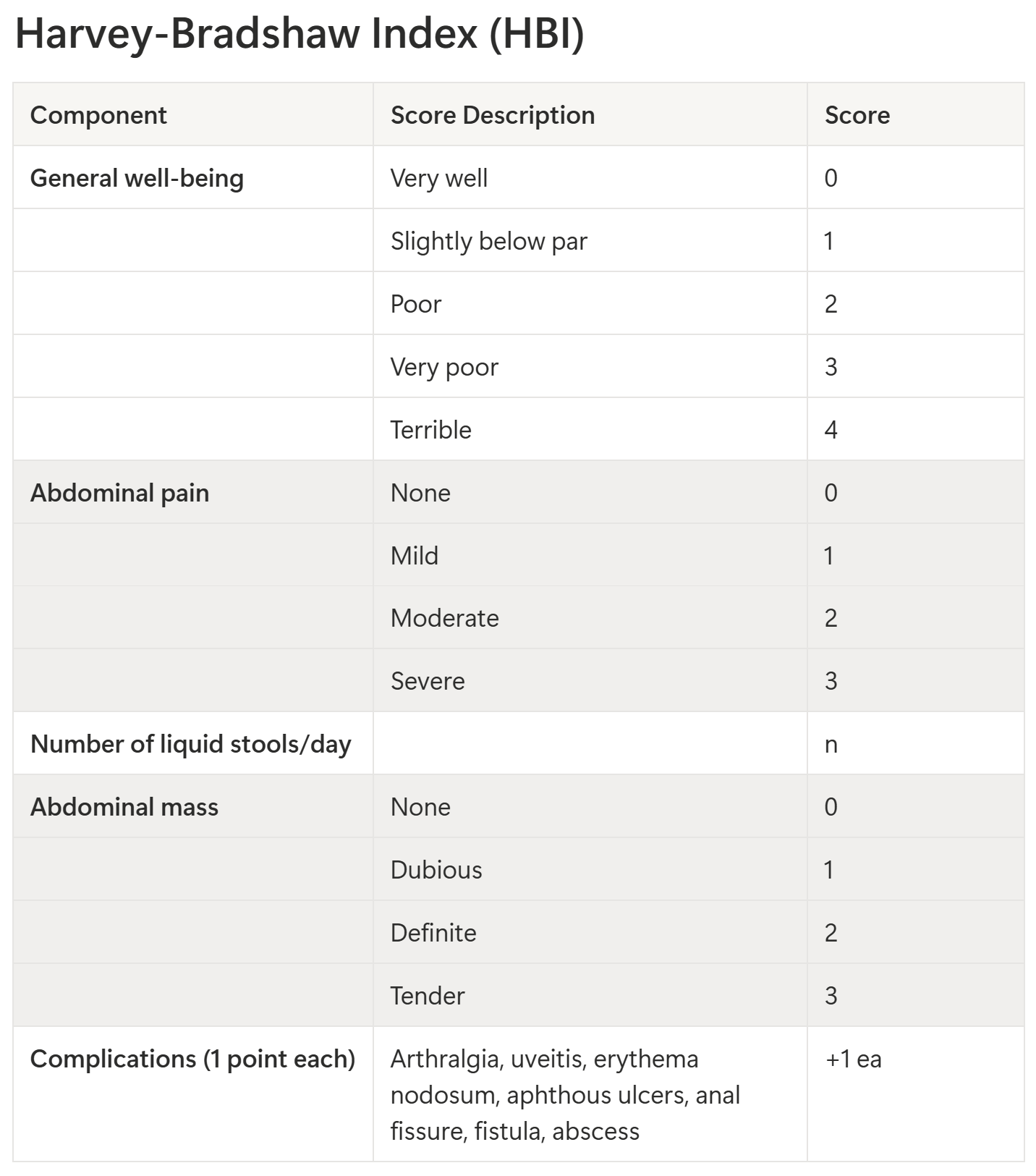
In mild-to-moderate disease, corticosteroids are the mainstay of induction therapy. Oral budesonide is preferred for Crohn’s disease affecting the ileum and/or ascending colon due to its high first-pass metabolism and more favourable systemic side-effect profile compared to conventional corticosteroids. Oral prednisolone is used for more severe or extensive disease.
In moderate-to-severe or corticosteroid-refractory disease, advanced therapies are indicated. Biological therapies include Tumour Necrosis Factor-alpha (TNF-α) inhibitors such as infliximab and adalimumab; the gut-selective α4β7 integrin inhibitor vedolizumab; Interleukin-12/23 (IL-12/23) inhibitor such as ustekinumab; and Interleukin-23 (IL-23) inhibitors such as risankizumab, mirikizumab and guselkumab. The Janus kinase (JAK) inhibitor upadacitinib is also licensed for moderately to severely active Crohn’s disease in the UK. Combination therapy with an immunomodulator such as azathioprine or mercaptopurine is recommended with TNF-α inhibitors to reduce immunogenicity. Surgery, including bowel resection, remains an important treatment option for patients with stricturing or fistulating disease or those who are refractory to medical therapy.
Maintaining Remission
Once remission has been achieved, ongoing therapy is required to prevent relapse. Options for maintenance include azathioprine, mercaptopurine and methotrexate, which are used as immunomodulators. Biological therapies and JAK inhibitors used to induce remission are generally continued for maintenance in patients with moderate-to-severe disease. Mesalazine is not recommended for the maintenance of remission in Crohn’s disease by major guidelines, including the British Society of Gastroenterology (BSG) and the European Crohn’s and Colitis Organisation (ECCO), owing to a lack of robust supporting evidence, regardless of disease distribution.
Preventing Relapse
The most evidence-based strategy for preventing relapse is adherence to maintenance medication. Smoking cessation is particularly important in Crohn’s disease, as smoking is a well-established risk factor for disease activity. This should be done slowly to prevent the risk of flaring. Patients should also be advised to identify and, where possible, avoid personal trigger factors, which may include dietary factors and psychological stress.
Ulcerative colitis

Ulcerative colitis (UC) is a long-term inflammatory condition affecting the large intestine (colon) and rectum. Inflammation begins at the rectum and extends proximally in a continuous and diffuse pattern, potentially involving the entire colon (extensive colitis/pancolitis). The extent of disease is classified by the Montreal Classification as proctitis (E1), left-sided colitis (E2) or extensive colitis (E3).
Predominant symptoms of active disease include bloody diarrhoea with mucus and/or pus, urgency and frequency in passing faeces, and abdominal pain. If inadequately managed, UC can be associated with extraintestinal manifestations (EIMs). UC is also associated with life-threatening acute gastrointestinal complications, including toxic megacolon and bowel perforation. In addition, chronic, longstanding inflammation is associated with an increased risk of colorectal cancer, particularly in patients with extensive disease and prolonged disease duration.
As with Crohn’s disease, the aims of treatment include inducing remission, maintaining remission and preventing relapse.
Inducing Remission
Disease severity is classified as mild, moderate or severe using validated scoring tools such as the Truelove and Witts Severity Index or the Mayo Score, and treatment is guided by both severity and the extent of inflammation.
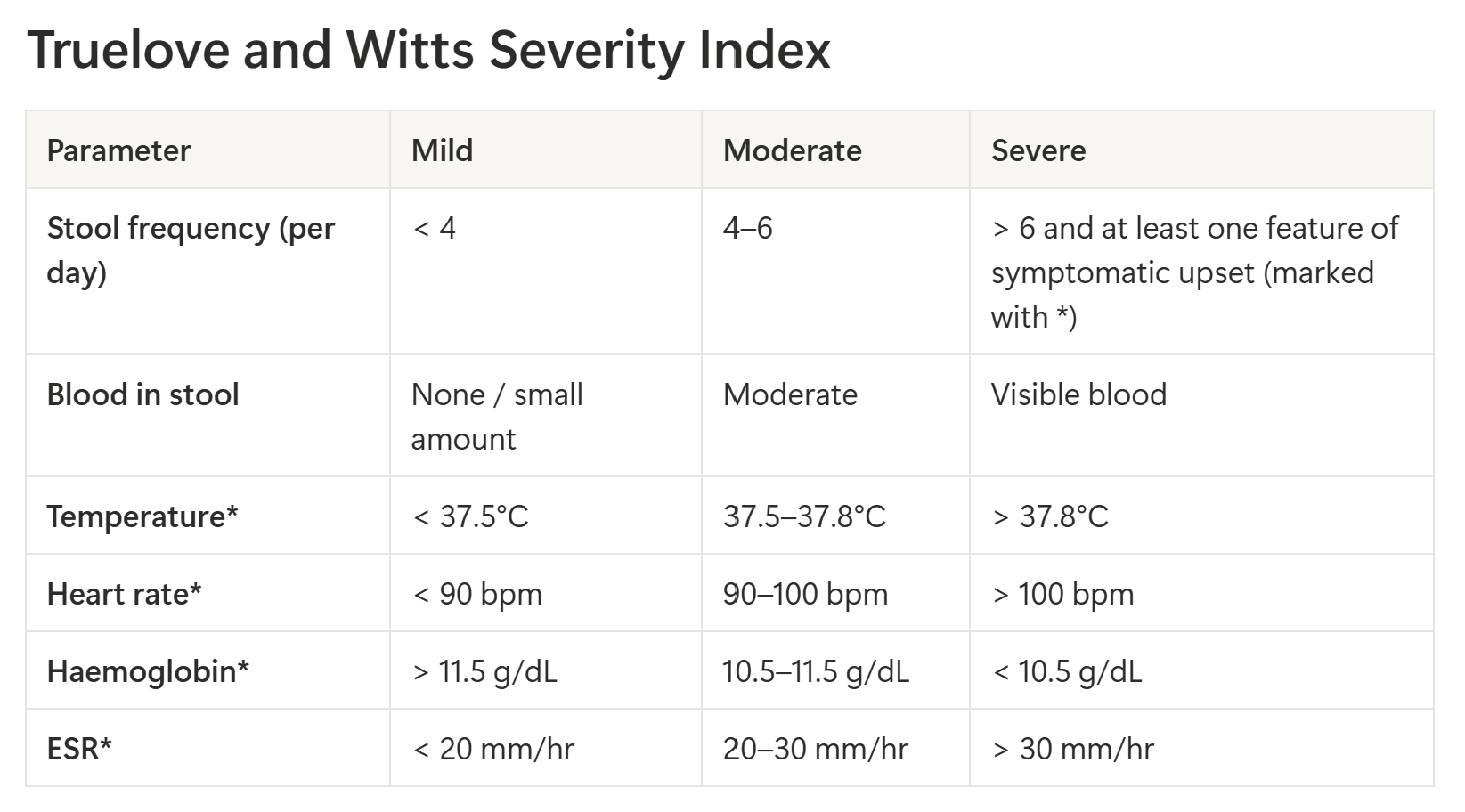
In mild-to-moderate disease, treatment is determined by disease extent. Proctitis is treated with topical mesalazine as first-line therapy, with topical corticosteroids or oral mesalazine used as adjuncts if needed. In left-sided and extensive disease, the combination of oral and topical mesalazine is more effective than either alone and is recommended by the BSG and the National Institute for Health and Care Excellence (NICE) as first-line therapy. In patients who fail to respond to aminosalicylate therapy, corticosteroids can be added to induce remission.
In moderate-to-severe disease, oral corticosteroids are typically used. In acute severe ulcerative colitis (ASUC), patients require hospital admission and treatment with intravenous corticosteroids as first-line therapy. In those who fail to respond within 72 hours, rescue therapy with either intravenous ciclosporin (off-label) or infliximab should be considered. In refractory or frequently relapsing moderate-to-severe disease, a range of advanced therapies may be used, including biological therapies such as infliximab, adalimumab, golimumab, vedolizumab, ustekinumab, risankizumab, mirikizumab and guselkumab; JAK inhibitors such as tofacitinib, filgotinib and upadacitinib; and Sphingosine-1-phosphate (S1P) receptor modulators such as ozanimod and etrasimod. Surgery in the form of colectomy remains an important option in patients with refractory disease or those who develop life-threatening complications.
Maintaining Remission
Once remission has been achieved, ongoing treatment is required to maintain it. Options include mesalazine, azathioprine or mercaptopurine, and advanced therapies – including biological agents, JAK inhibitors and S1P receptor modulators – in patients with more complex or refractory disease. The choice of maintenance therapy is guided by the treatment used to induce remission, disease severity and patient factors.
Preventing Relapse
The most evidence-based strategy for preventing relapse is adherence to maintenance medication, particularly mesalazine in patients with mild-to-moderate disease. Patients should also be advised to identify and, where possible, avoid personal trigger factors, which may include dietary factors and psychological stress, though the evidence for these as modifiable relapse triggers is less robust than for medication adherence.
Mesalazine

Mesalazine is an aminosalicylate used primarily in the management of ulcerative colitis. Major guidelines, including those from BSG and ECCO, do not recommend mesalazine for either the induction or maintenance of remission in Crohn's disease, owing to a lack of robust supporting evidence.
Different preparations are released at different parts of the gastrointestinal tract. Pentasa® is time-dependent and starts releasing the active drug from the duodenum to the colon. Mezavant XL®, Octasa® and Asacol® are pH-dependent and start releasing at pH≥7 in the terminal ileum to the entire colon. Salofalk® is also pH dependent and releases at pH≥6 from the mid-ileum to the colon. Therefore, it is recommended that mesalazine should be prescribed by brand.
Azathioprine

Azathioprine is an immunomodulator used to maintain remission in IBD. It can also be used alongside TNF-α inhibitors such as infliximab, adalimumab or golimumab to reduce immunogenicity and help preserve their therapeutic effects.
Azathioprine is converted to mercaptopurine via a non-enzymatic glutathione-mediated reaction. Mercaptopurine then undergoes metabolism via competing pathways. Thiopurine methyltransferase (TPMT) converts mercaptopurine to the pharmacologically inactive metabolite 6-methylmercaptopurine (MeMP), which is also hepatotoxic. Alternatively, xanthine oxidase converts mercaptopurine to the inactive metabolite 6-thiouric acid. The remaining mercaptopurine is channelled toward the production of 6-thioguanine nucleotides (TGN), the pharmacologically active metabolites responsible for immunosuppression through incorporation into DNA and inhibition of purine synthesis, leading to suppression of T-lymphocyte proliferation.
TPMT activity significantly influences the balance of these metabolites. Before initiating therapy, TPMT activity should be tested. Patients with low or absent TPMT activity are unable to efficiently methylate mercaptopurine, meaning it is almost entirely channelled toward TGN production, placing them at serious risk of profound myelosuppression and life-threatening bone marrow toxicity. Conversely, patients with high TPMT activity rapidly convert mercaptopurine to MeMP, producing subtherapeutic TGN levels. In these patients, low-dose allopurinol can be co-administered to inhibit xanthine oxidase, blocking an alternative degradation pathway and redirecting metabolism toward TGN production. However, when allopurinol is used, the azathioprine or mercaptopurine dose must be reduced by approximately 25-33% to avoid toxic TGN accumulation.
Therapeutic drug monitoring (TDM) can be performed by measuring TGN and MeMP levels, helping clinicians to guide dose optimisation, assess adherence, and identify toxicity in patients taking azathioprine or mercaptopurine.
Extraintestinal manifestation of IBD

Approximately 25-40% of people living with IBD develop extraintestinal manifestations (EIMs), which are conditions that occur outside the gastrointestinal tract.
EIMs can affect multiple organ systems, and joint disease is one of the most common manifestations. One type is pauciarticular, affecting fewer than five large joints and typically paralleling intestinal disease activity. The other is polyarticular, involving five or more small joints and following a course that is independent of bowel inflammation. Cutaneous manifestations include erythema nodosum and pyoderma gangrenosum. Ocular manifestations include episcleritis, which is the most common eye complaint, and uveitis, which is less common but more serious.
Metabolic and nutritional complications are also common. IBD is a recognised cause of secondary osteoporosis, resulting from chronic inflammation, corticosteroid use, and malabsorption. Osteomalacia can occur, particularly in patients with small bowel Crohn’s disease, where vitamin D malabsorption is more pronounced. Iron deficiency anaemia (IDA) and anaemia of chronic disease (ACD) are both frequently encountered. Deficiencies in folate and vitamin B12 can also occur, the latter being especially relevant in patients with ileal Crohn’s disease or those who have undergone ileal resection.
Hepatobiliary complications include gallstones, which are more prevalent in patients with ileal Crohn’s disease due to impaired bile acid reabsorption, and primary sclerosing cholangitis (PSC), which occurs more frequently in ulcerative colitis than Crohn’s disease. IBD is associated with a prothrombotic state due to chronic inflammation, predisposing patients to venous thromboembolic (VTE) complications such as deep vein thrombosis (DVT) and portal vein thrombosis (PVT); this risk is present in both Crohn’s disease and ulcerative colitis. The risk of VTE is estimated to be approximately 2-3 fold higher than in the general population and is further elevated during active flares and hospitalisation. VTE prophylaxis should therefore be considered in all hospitalised IBD patients with an active flare, in accordance with local and national guidelines.
References
British Society of Gastroenterology guidelines on inflammatory bowel disease in adults: 2025 (2025) (https://doi.org/10.1136/gutjnl-2024-334395)
ECCO Guidelines on Extraintestinal Manifestations in Inflammatory Bowel Disease (2023) (https://doi.org/10.1093/ecco-jcc/jjad108)
ECCO Guidelines on Therapeutics in Crohn’s Disease: Medical Treatment (2024) (https://doi.org/10.1093/ecco-jcc/jjae091)
ECCO Guidelines on Therapeutics in Ulcerative Colitis: Medical Treatment (2021) (https://doi.org/10.1093/ecco-jcc/jjab178)
NICE: Inflammatory bowel disease (2026) (https://www.nice.org.uk/guidance/conditions-and-diseases/digestive-tract-conditions/inflammatory-bowel-disease)
SPS: Using mesalazine tablets appropriately (2025) (https://www.sps.nhs.uk/articles/using-mesalazine-tablets-appropriately/)